
The First Open Weight Model for Deterministic Work: Interfaze 1 Lite
copy markdown
Almost every model you can call today was trained to write for a person. interfaze-1-lite is built to be read by your code: open weights, one GPU, and a confidence score on everything it reads.



Models for people, models for machines
A chat model's answer is judged by the person reading it. If it's a little off, the reader notices, rephrases, and moves on.
In a pipeline, the reader is an if statement. It can't tell a confident answer from a lucky guess, so every mistake flows straight into your database.
That changes what a good output looks like:
| Built for a person | Built for a program | |
|---|---|---|
| Output | Prose that reads well | Typed fields that match a schema |
| Labels | Any word that sounds right | Only values from the set you defined |
| Location | "Near the top of page 2" | A bounding box, a page number, a timestamp |
| Confidence | Implied by tone | A number on every line, word and field |
| Consistency | Nice to vary from run to run | Same input, same output |
| Mistakes | Caught by the reader | Caught by a threshold, or not at all |
The confidence score is the one that matters most. A model that is right 95% of the time can't automate a task unless it also tells you which answers are in the other 5%.
With a score, the rule is simple: act on anything above your threshold and send the rest to a person. Without one, a person has to check everything, and nothing is automated.
Introducing interfaze-1-lite
interfaze-1-lite is an open-weight, any-to-text model for deterministic work. It takes text, images, audio and files, including PDFs and Word documents, and returns text or JSON that matches your schema.
It's built for tasks where there's one right answer:
- OCR with a box and confidence for every line and word
- Speech-to-text with speaker diarization
- Classification and structured extraction into your schema
- Object detection and GUI detection
- Translation, forecasting and guardrails
The weights are Apache 2.0 and the whole model runs on a single 80 GB GPU. Through the API it's $0.85 per million input tokens and $1.50 per million output tokens.
| interfaze-1-lite | |
|---|---|
| Input price | $0.85 / MTok |
| Output price | $1.50 / MTok |
| Context window | 128k tokens |
| Max output tokens | 32k tokens |
| Input | Text, images, audio, files |
| Output | Text, JSON |
| Reasoning | Available |
| PDF pages | Up to 50 per request |
| Open weights | Yes, runs on one 80 GB GPU |
| License | Apache 2.0 |
The architecture
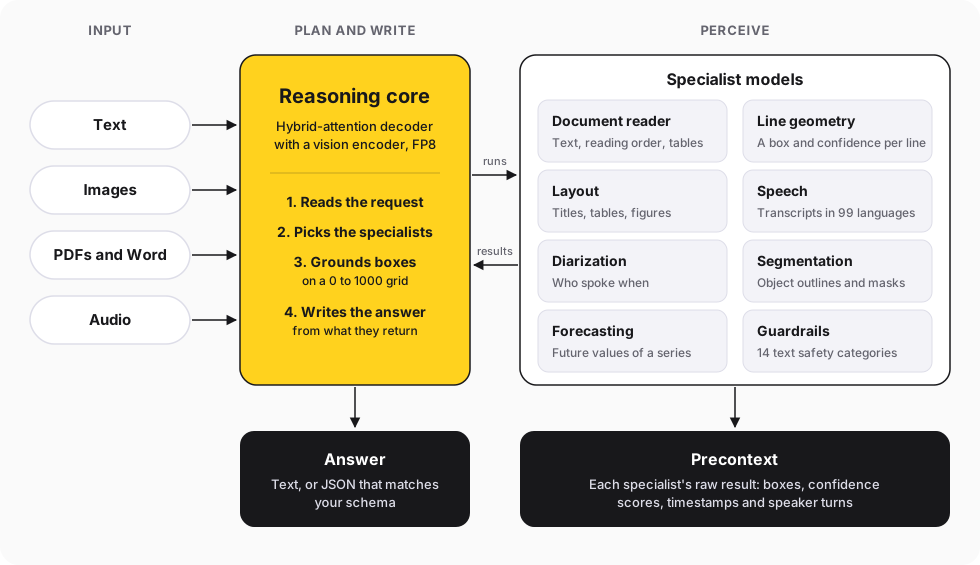
Lite isn't one network. It's a reasoning core plus specialist models, each built for one kind of perception.
The core reads the request, decides which specialists to run, and writes the answer from what they return. The specialists do the reading, listening and locating that a general model is weakest at.
Why split it up
A single vision-language model can read a page well. But it reads the way a person does: it gives you the words, not where they are or how sure it was.
Specialists produce that metadata as part of how they work. A text detector scores every line it finds, and a speech recognizer timestamps every word.
| Approach | Reads the content | Exact positions | Confidence per line | Handles nuance |
|---|---|---|---|---|
| General VLM alone | Yes | Approximate | No | Yes |
| Specialist models alone | Yes | Yes | Yes | No |
| Lite: core + specialists | Yes | Yes | Yes | Yes |
The core keeps what makes an LLM useful: it understands the request, follows your schema and reasons about what it read. The specialists keep what makes classic models useful: precise output with a score attached.
How the parts combine
OCR stitches two views of one page. The document reader supplies the text in reading order, and the line detector supplies the geometry and confidence.
Each detected line takes the reader's words for it. The box is exact, the text is complete, and the confidence comes with it.
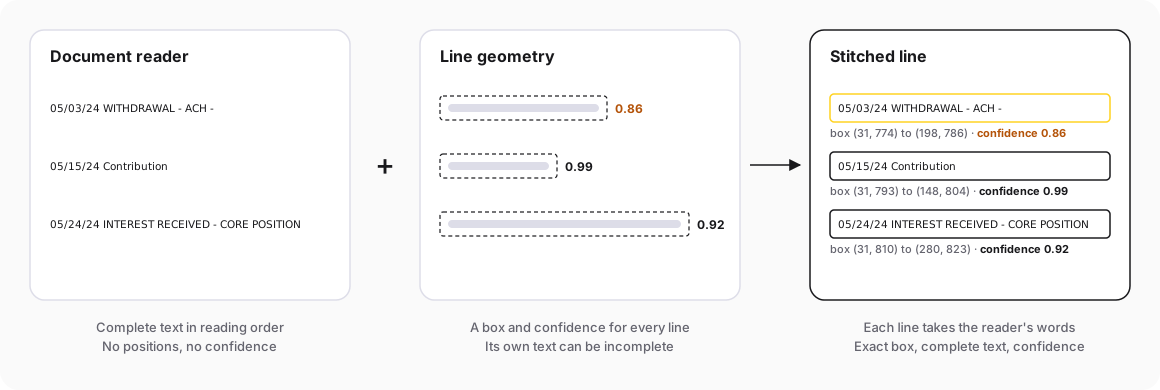
These are real lines and scores from the bank statement in the example below.
The other parts combine the same way:
- Speakers are attributed per word, by the largest overlap with each speaker's turns, then grouped into chunks.
- Detection and GUI grounding run on the reasoning core, which returns boxes on a 0 to 1000 grid. Outlines come from the segmentation model.
- A run task skips planning. Naming one capability runs that specialist directly and returns its raw result.
Everything the specialists produce comes back in precontext, next to the answer. Your code gets the clean JSON and the evidence behind it in the same response.
Benchmarks
Lite is on the leaderboard next to Gemini-3.7-Flash, Claude-Sonnet-5, GPT-5.4-Mini and Grok-4.3. Bold marks where Lite beats all four.
| Benchmark | Task | interfaze-1-lite | interfaze-1 | Best of the other four |
|---|---|---|---|---|
| MMMU-Pro | Multimodal reasoning | 73.2% | 71.1% | Grok-4.3, 68.7% |
| RefCOCO | Visual grounding | 83.8% | 82.1% | Gemini-3.7-Flash, 80.9% |
| SOB value accuracy | Structured output | 81.5% | 80.5% | Gemini-3.7-Flash, 80.2% |
| olmOCR | Document OCR | 83.8% | 85.7% | Claude-Sonnet-5, 83.5% |
| VoxPopuli WER (lower is better) | Speech recognition | 3.0% | 2.4% | Gemini-3.7-Flash, 4.0% |
| Spider 2.0-Lite | Text-to-SQL | 48.9% | 52.9% | Claude-Sonnet-5, 50.6% |
| GPQA Diamond | PhD-level science | 85.9% | 92.4% | Gemini-3.7-Flash, 91.4% |
| OCRBench V2 | Text in images | 60.9% | 70.7% | Gemini-3.7-Flash, 63.9% |
| MMMLU | Multilingual knowledge | 87.8% | 90.9% | Grok-4.3, 89.7% |
Lite leads on multimodal reasoning, visual grounding, structured output, document OCR and speech. It even edges out our flagship on MMMU-Pro, RefCOCO and SOB.
It trails on text in images, general knowledge and science questions. For those, interfaze-1 scores higher.
View the full benchmark breakdown →
Self-hosting
The weights are on Hugging Face under the Apache 2.0 license. The whole model runs on a single 80 GB GPU with no external services, so it works offline.
You need a GPU with compute capability 8.9 or newer, like an H100, and ffmpeg for audio.
hf download interfaze-ai/interfaze-1-lite requirements.txt --local-dir .
pip install -r requirements.txt
Load it with Transformers and call chat, the same entry point the API uses. The core plans, runs the specialists it needs and answers.
from transformers import AutoModel

model = AutoModel.from_pretrained("interfaze-ai/interfaze-1-lite", trust_remote_code=True)

answer = model.chat(
    [{"role": "user", "content": "What is the total, and which item is highlighted?"}],
    files=["receipt.jpg"],
)
print(answer["content"])
To skip planning, call one capability directly. ocr runs the document reader and line geometry and returns the stitched page.
doc = model.ocr("invoice.pdf", page_range=[1, 2])
print(doc["text"])
The model card covers every capability's method, arguments and output.
Transformers is slower than a batching serving engine. For throughput, use the API.
Use it with the Interfaze API
To try it without code, open the playground and pick interfaze-1-lite from the model picker. It shows the answer and the precontext behind it.
In code, set model to interfaze-1-lite. Everything else works the same as interfaze-1, including structured output and precontext.
Interfaze SDK
Vercel AI SDK
LangChain SDK
import { Interfaze } from "interfaze";

const interfaze = new Interfaze({ apiKey: process.env.INTERFAZE_API_KEY });

const response = await interfaze.chat.completions.create({
	model: "interfaze-1-lite",
	messages: [
		{
			role: "user",
			content: [
				{ type: "text", text: "Extract the details from this ID" },
				{ type: "image_url", image_url: { url: "https://r2public.jigsawstack.com/interfaze/examples/id.jpg" } },
			],
		},
	],
});

console.log(response.choices[0]?.message.content);
Interfaze speaks the Chat Completions standard, so any OpenAI-compatible SDK works too. Point it at https://api.interfaze.ai/v1 with your key from the dashboard.
Example: read a bank statement, classify every row
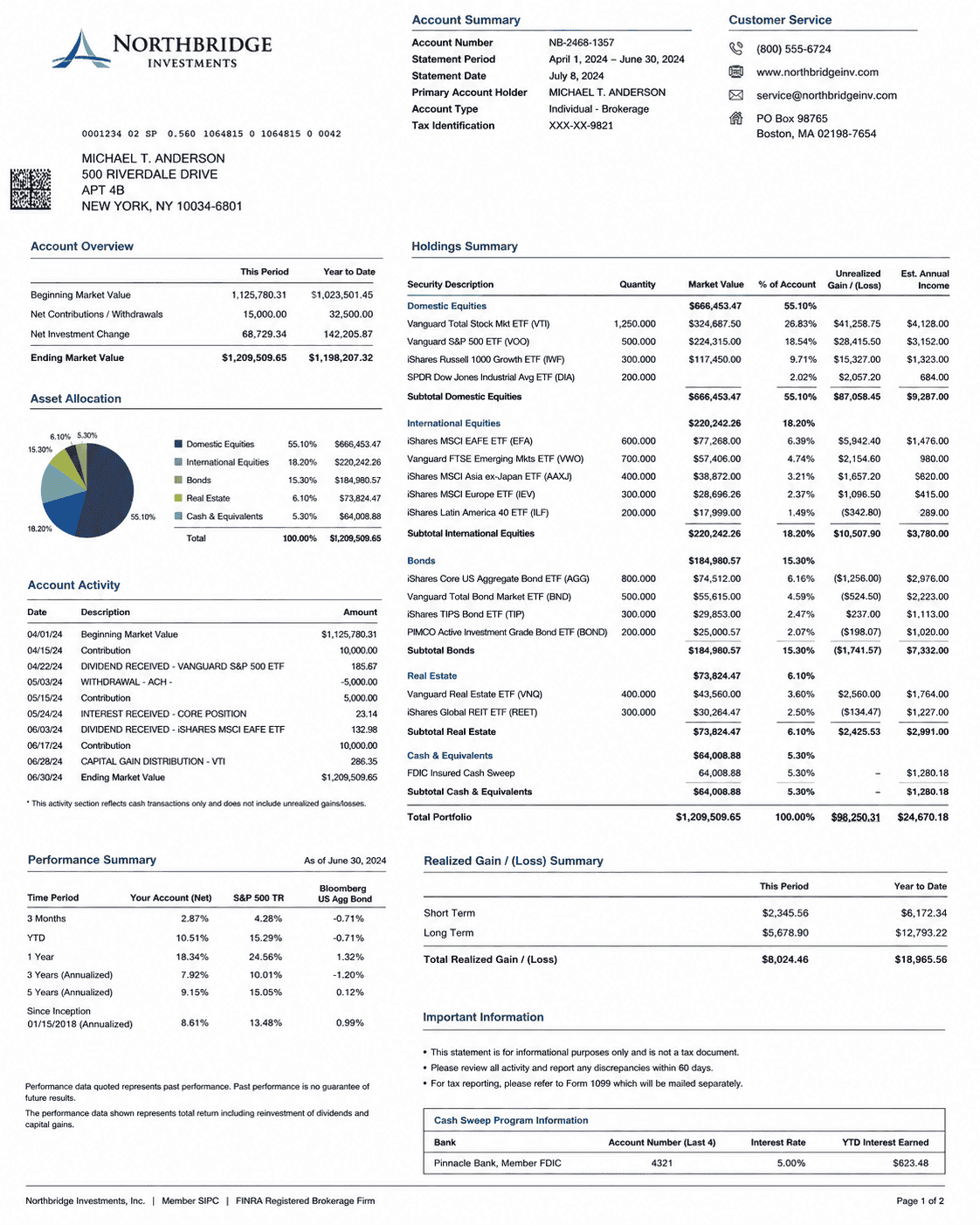
Here's the kind of job Lite is built for. A brokerage statement comes in as an image, and your bookkeeping system needs every account activity row as a typed record with a category.
The plan:
- Extract the account details and every activity row into a schema.
- Classify each row into a fixed set of categories, defined as an enum so no other label can come back.
- Gate each row on the OCR confidence of the line it came from. Rows above 0.9 post automatically, the rest go to a person.
Interfaze SDK
Vercel AI SDK
LangChain SDK
import { Interfaze, responseFormat } from "interfaze";
import { z } from "zod";

const interfaze = new Interfaze({ apiKey: process.env.INTERFAZE_API_KEY });

const StatementSchema = z.object({
	account_number: z.string(),
	account_holder: z.string(),
	statement_period: z.string(),
	transactions: z.array(
		z.object({
			date: z.string(),
			description: z.string(),
			amount: z.number(),
			category: z.enum(["contribution", "withdrawal", "dividend", "interest", "capital_gain", "balance"]),
		})
	),
});

const response = await interfaze.chat.completions.create({
	model: "interfaze-1-lite",
	messages: [
		{
			role: "user",
			content: [
				{ type: "text", text: "Extract the account details and every Account Activity row, and classify each row." },
				{
					type: "image_url",
					image_url: { url: "https://r2public.jigsawstack.com/interfaze/examples/financial_document_example.png" },
				},
			],
		},
	],
	response_format: responseFormat(z.toJSONSchema(StatementSchema), "bank_statement"),
});

type OcrLine = { text: string; average_confidence: number };
type OcrResult = { sections: { lines: OcrLine[] }[] };

const statement = StatementSchema.parse(JSON.parse(response.choices[0]?.message.content ?? "{}"));
const ocr = response.precontext?.find((p) => p.name === "ocr")?.result as OcrResult | undefined;
const lines = ocr?.sections.flatMap((section) => section.lines) ?? [];

const REVIEW_BELOW = 0.9;

for (const row of statement.transactions) {
	const line = lines.find((l) => l.text.startsWith(row.date));
	const confidence = line?.average_confidence ?? 0;
	const status = confidence >= REVIEW_BELOW ? "auto" : "review";
	console.log(status, row.date, row.category, row.amount, confidence);
}
The output
The schema response has every row, typed and classified. The withdrawal even keeps its minus sign.
{
  "account_number": "NB-2468-1357",
  "account_holder": "MICHAEL T. ANDERSON",
  "statement_period": "April 1, 2024 - June 30, 2024",
  "transactions": [
    { "date": "04/01/24", "description": "Beginning Market Value", "amount": 1125780.31, "category": "balance" },
    { "date": "04/15/24", "description": "Contribution", "amount": 10000, "category": "contribution" },
    { "date": "04/22/24", "description": "DIVIDEND RECEIVED - VANGUARD S&P 500 ETF", "amount": 185.67, "category": "dividend" },
    { "date": "05/03/24", "description": "WITHDRAWAL - ACH -", "amount": -5000, "category": "withdrawal" },
    { "date": "05/15/24", "description": "Contribution", "amount": 5000, "category": "contribution" },
    { "date": "05/24/24", "description": "INTEREST RECEIVED - CORE POSITION", "amount": 23.14, "category": "interest" },
    { "date": "06/03/24", "description": "DIVIDEND RECEIVED - ISHARES MSCI EAFE ETF", "amount": 132.98, "category": "dividend" },
    { "date": "06/17/24", "description": "Contribution", "amount": 10000, "category": "contribution" },
    { "date": "06/28/24", "description": "CAPITAL GAIN DISTRIBUTION - VTI", "amount": 286.35, "category": "capital_gain" },
    { "date": "06/30/24", "description": "Ending Market Value", "amount": 1209509.65, "category": "balance" }
  ]
}
Precontext carries the OCR behind it, with a box and confidence for every line and word. Here it is trimmed to the withdrawal line, without the per-word boxes:
{
  "name": "ocr",
  "result": {
    "extracted_text": "Account Summary\nCustomer Service\n...",
    "sections": [
      {
        "lines": [
          {
            "text": "05/03/24 WITHDRAWAL - ACH -",
            "bounds": {
              "top_left": { "x": 31, "y": 774 },
              "top_right": { "x": 198, "y": 774 },
              "bottom_right": { "x": 198, "y": 786 },
              "bottom_left": { "x": 31, "y": 786 }
            },
            "average_confidence": 0.86,
            "words": [
              { "text": "05/03/24", "confidence": 0.99 },
              { "text": "WITHDRAWAL", "confidence": 0.99 },
              { "text": "-", "confidence": 0.92 },
              { "text": "ACH", "confidence": 0.99 },
              { "text": "-", "confidence": 0.42 }
            ]
          }
        ]
      }
    ]
  }
}
And the gate prints:
auto 04/01/24 balance 1125780.31 0.99
auto 04/15/24 contribution 10000 0.98
auto 04/22/24 dividend 185.67 0.95
review 05/03/24 withdrawal -5000 0.86
auto 05/15/24 contribution 5000 0.99
auto 05/24/24 interest 23.14 0.92
auto 06/03/24 dividend 132.98 0.95
auto 06/17/24 contribution 10000 0.98
auto 06/28/24 capital_gain 286.35 0.98
auto 06/30/24 balance 1209509.65 0.99
Nine rows post on their own. The withdrawal goes to a person, because the trailing dash after "ACH" read at 0.42 and pulled the line down to 0.86.
The extraction was right, and a reviewer confirms it in seconds. That's the point: the model told you exactly which row to look at, and the box tells the reviewer exactly where on the page to look.
A chat model would have returned the same JSON with no way to tell which row was shaky. Here, the category can't fall outside your enum, and every row carries the confidence of the text it came from.