
Qwen3.8 Flash Next GGUF
Qwen3.8 Flash Next GGUF by unsloth, a image-text-to-text model with multimodal capabilities. Understand and compare multimodal features, benchmarks, and capabilities.
Comparison
| Feature | Qwen3.8 Flash Next GGUF | Interfaze |
|---|---|---|
| Input Modalities | text, image, video, document | image, text, audio, video, document |
| Native OCR | No | Yes |
| Long Document Processing | No | Yes |
| Language Support | 29 partial | 162+ |
| Native Speech-to-Text | No | Yes |
| Native Object Detection | No | Yes |
| Guardrail Controls | No | Yes |
| Context Input Size | 1M | 1M |
| Tool Calling | Yes | Tool calling supported + built in browser, code execution and web search |
Scaling
| Feature | Qwen3.8 Flash Next GGUF | Interfaze |
|---|---|---|
| Scaling | Self-hosted/Provider-hosted with quantization | Unlimited |
View model card on Hugging Face
As the frontier of foundation models pushes toward ever-larger parameter counts and ever-longer context windows, the question is no longer just how much we can scale, but how efficiently we can do so. Sustainable progress toward artificial general intelligence (AGI) that benefits everyone demands architectural innovation. Today, we are sharing a concrete step in that direction: Qwen3.8-Flash-Next.
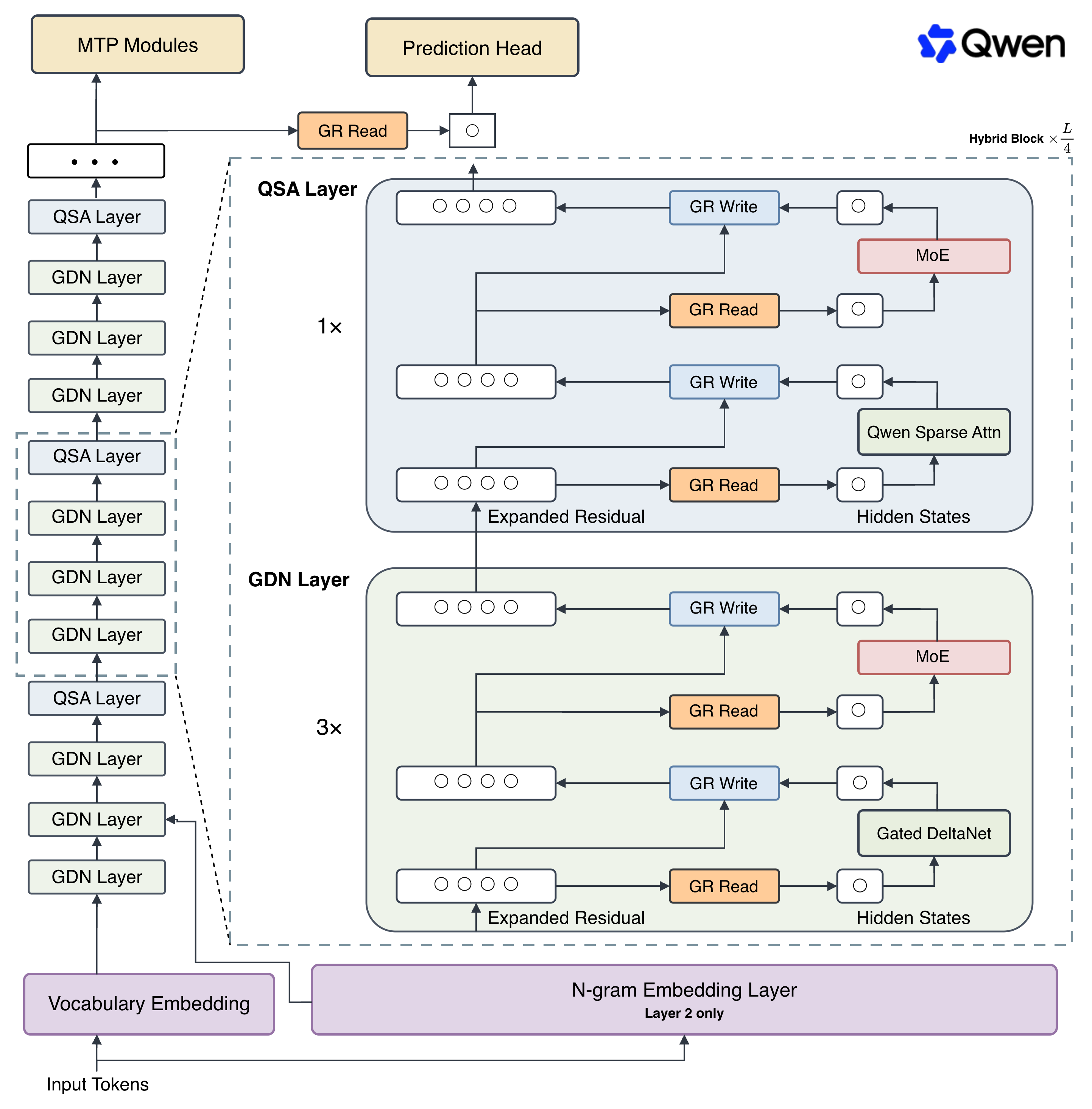
This experimental preview of the architecture that will underpin Qwen4 is built around a fundamental rethinking of how the core components of modern large language models (LLMs) interact at scale.
Highlights
The first open-weight release under this architecture is Qwen3.8-Flash-Next, which introduces:
- Hybrid Attention with QSA: The Gated DeltaNet and Gated Attention pairing has been reworked into Gated DeltaNet and Qwen Sparse Attention (QSA). Rather than selecting individual tokens for processing, QSA operates at the micro-block level. This cuts long-context latency significantly, a critical gain as agentic workloads increasingly dominate real-world usage.
- Gated Residual: Residual streams with normalization are what make deep LLM training manageable. Gated Residual modulates information flowing through widened residual streams via an element-wise, data-dependent read gate and a per-branch scalar write gate. This brings finer-grained expressiveness across layers while preserving training stability and keeping inference overhead low.
- N-gram Embedding: Embeddings provide a unique axis for parameter scaling that requires less computation and is more amenable to offloading than Mixture-of-Experts (MoE). By indexing with short n-grams, this approach makes parameter scaling highly efficient for memory-constrained accelerators without sacrificing quality.
- Tailored Training Recipe: The Muon and AdamW optimizers are applied to specific weight categories to maximize efficiency. Guided by refitted scaling laws, we eliminate traditional batch-size warmups and start directly at the target batch size, substantially reducing total optimizer steps while safely supporting larger learning rates for robust convergence.
For more details, please refer to our blog post Qwen3.8-Flash-Next and the technical report.
We are excited to embark on this next chapter with you and welcome your feedback as we build what comes next.
Model Overview
- Type: Causal Language Model with Vision Encoder
- Training Stage: Pre-training & Post-training
- Language Model
- Number of Parameters: 125B with 6B activated, plus 51B n-gram embedding and 4B MTP
- Hidden Dimension: 2560
- Token Embedding: 248320 (Padded)
- N-gram Embedding: 20,000,000 (bigrams/trigrams at layer 2)
- Number of Layers: 48
- Hidden Layout: 12 × (3 × (Gated DeltaNet → MoE) → 1 × (Qwen Sparse Attention → MoE))
- Gated DeltaNet:
- Number of Linear Attention Heads: 48 for V and 16 for QK
- Head Dimension: 128
- Qwen Sparse Attention:
- Number of Attention Heads: 24 for Q and 2 for KV
- Head Dimension: 256
- Rotary Position Embedding Dimension: 64
- Indexer Structure: MQA with 4 Query Heads and 1 Shared Key Head
- Indexer Head Dimension: 128
- Budget: 512 blocks or 2048 tokens
- Mixture Of Experts
- Number of Experts: 512
- Number of Activated Experts: 10 Routed + 1 Shared
- Expert Intermediate Dimension: 640
- Gated Residual:
- Number of Branches: 4
- Bottleneck Rank: 320
- LM Output: 248320 (Padded)
- MTP: 1 layer, trained with multi-steps
- Context Length: 262,144 natively and extensible up to 1,000,000 tokens.
Benchmark Results
Language
Vision Language
API Usage
[!Important] Qwen3.8-Flash-Next models operate in thinking mode by default, generating thinking content signified by
<think>\n...</think>\n\nbefore producing the final responses. To disable thinking content and obtain direct response, refer to the examples here.
[!Tip] We recommend using the following sets of sampling parameters for generation:
- Thinking Mode:
temperature=1.0,top_p=0.95,top_k=20,min_p=0.0,presence_penalty=0.0,repetition_penalty=1.0- Instruct (or non-thinking) mode:
temperature=0.7,top_p=0.80,top_k=20,min_p=0.0,presence_penalty=1.5,repetition_penalty=1.0Please note that the support for sampling parameters varies according to inference frameworks.
[!Tip] In multi-turn agentic tasks, lower reasoning effort does not always reduce overall task completion time. Although it may produce faster per-turn responses, it can also lead to insufficient analysis, more failures, and repeated retries, which may increase total latency and token consumption.
Qwen3.8-Flash-Next supports controlling thinking behavior via enable_thinking, preserve_thinking, and reasoning_effort.
t; supported levels are xhigh, medium, and low stream=True, stream_options={"include_usage": True}, )
Instruct (or Non-Thinking) Mode
Qwen3.8-Flash-Next will think by default before responding. You can obtain a direct response from the model without thinking by configuring the API parameters. For example,
from openai import OpenAI

client = OpenAI()

messages = [
    {
        "role": "user",
        "content": [
            {
                "type": "image_url",
                "image_url": {
                    "url": "https://qianwen-res.oss-accelerate.aliyuncs.com/Qwen3.5/demo/RealWorld/RealWorld-04.png"
                }
            },
            {
                "type": "text",
                "text": "Where is this?"
            }
        ]
    }
]

chat_response = client.chat.completions.create(
    model="Qwen/Qwen3.8-Flash-Next",
    messages=messages,
    temperature=0.7,
    top_p=0.8,
    presence_penalty=1.5,
    extra_body={
        "top_k": 20,
        "chat_template_kwargs": {"enable_thinking": False},
    },
)
print("Chat response:", chat_response)
[!Note] If you are using APIs from Qwen Cloud, in addition to changing
model, please use"enable_thinking": Falseinstead of"chat_template_kwargs": {"enable_thinking": False}.
Disable Preserved Thinking
By default, Qwen3.8-Flash-Next retains thinking blocks from all historical messages, maintaining a complete reasoning trace across the conversation. This behavior, known as preserved thinking, ensures full context continuity and is especially beneficial for agent scenarios where decision consistency and reduced redundant reasoning are critical. It also improves KV cache utilization, optimizing inference efficiency in both thinking and non-thinking modes.
If you prefer to retain only the thinking blocks from the latest user message, you can disable this behavior by setting preserve_thinking to False:
from openai import OpenAI


client = OpenAI()
messages = [...]
chat_response = client.chat.completions.create(
    model="Qwen/Qwen3.8-Flash-Next",
    messages=messages,
    extra_body={
        "chat_template_kwargs": {"preserve_thinking": False},
    },
)
print("Chat response:", chat_response)
[!Note] If you are using APIs from Qwen Cloud, in addition to changing
model, please use"preserve_thinking": Falsedirectly instead of wrapping it inchat_template_kwargs.
Best Practices
To achieve optimal performance, we recommend the following settings:
-
Sampling Parameters: We suggest using the following sets of sampling parameters:
- Thinking Mode:
temperature=1.0,top_p=0.95,top_k=20,min_p=0.0,presence_penalty=0.0,repetition_penalty=1.0 - Instruct (or non-thinking) mode:
temperature=0.7,top_p=0.80,top_k=20,min_p=0.0,presence_penalty=1.5,repetition_penalty=1.0
For supported frameworks, you can adjust the
presence_penaltyparameter between 0 and 2 to reduce endless repetition. However, using a higher value may occasionally result in language mixing and a slight decrease in model performance. - Thinking Mode:
-
Adequate Output Length: To optimize performance on agentic tasks, we recommend allocating sufficient output length to allow the model to generate detailed and comprehensive responses. For frameworks that support separate token limits for internal reasoning and final outputs, we suggest the following configuration within the 1M context length:
- Reasoning Content: Set the maximum output length to 262,144 tokens.
- Final Response: Set the maximum output length to 131,072 tokens.
These settings provide the necessary capacity for complex reasoning while ensuring ample space for high-quality final deliverables.
-
Processing Ultra-Long Texts: Qwen3.8-Flash-Next natively supports context lengths of up to 262,144 tokens. For long-horizon tasks where the total length (including both input and output) exceeds this limit, we recommend using RoPE scaling techniques to handle long texts effectively, e.g., YaRN.
YaRN is currently supported by several inference frameworks, e.g., vLLM, SGLang, and TokenSpeed. In general, there are two approaches to enabling YaRN for supported frameworks:
-
Modifying the model configuration file:
In the
config.jsonfile, change therope_parametersfields intext_configto:{ "mrope_interleaved": true, "mrope_section": [ 11, 11, 10 ], "rope_type": "yarn", "rope_theta": 10000000, "partial_rotary_factor": 0.25, "factor": 4.0, "original_max_position_embeddings": 262144 }
[!NOTE] All the notable open-source frameworks implement static YaRN, which means the scaling factor remains constant regardless of input length, potentially impacting performance on shorter texts. We advise modifying the
rope_parametersconfiguration only when processing long contexts is required. It is also recommended to modify thefactoras needed. For example, if the typical context length for your application is 524,288 tokens, it would be better to setfactoras 2.0. -
-
Long Video Understanding: To optimize inference efficiency for plain text and images, the
sizeparameter in the releasedvideo_preprocessor_config.jsonis conservatively configured. It is recommended to set thelongest_edgeparameter in the video_preprocessor_config file to 469,762,048 (corresponding to 224k video tokens) to enable higher frame-rate sampling for hour-scale videos and thereby achieve superior performance. For example,{"longest_edge": 469762048, "shortest_edge": 4096}Alternatively, override the default values via engine startup parameters. For implementation details, refer to: vLLM / SGLang.
Citation
If you find our work helpful, feel free to give us a cite.
@techreport{qwen2026design,
    title       = {On the Design of {Qwen3.8-Next} Architecture: Evaluation, Efficiency, and Training Stability},
    author      = {{Qwen Team}},
    institution = {Alibaba Group},
    month       = {August},
    year        = {2026}
}

@misc{qwen3.8flashnext,
    title  = {{Qwen3.8-Flash-Next}: A New Architecture, Towards Ultimate Cost-Efficiency},
    author = {{Qwen Team}},
    month  = {August},
    year   = {2026},
    url    = {https://qwen.ai/blog?id=qwen3.8-flash-next}
}